

How does the LCD panel work?
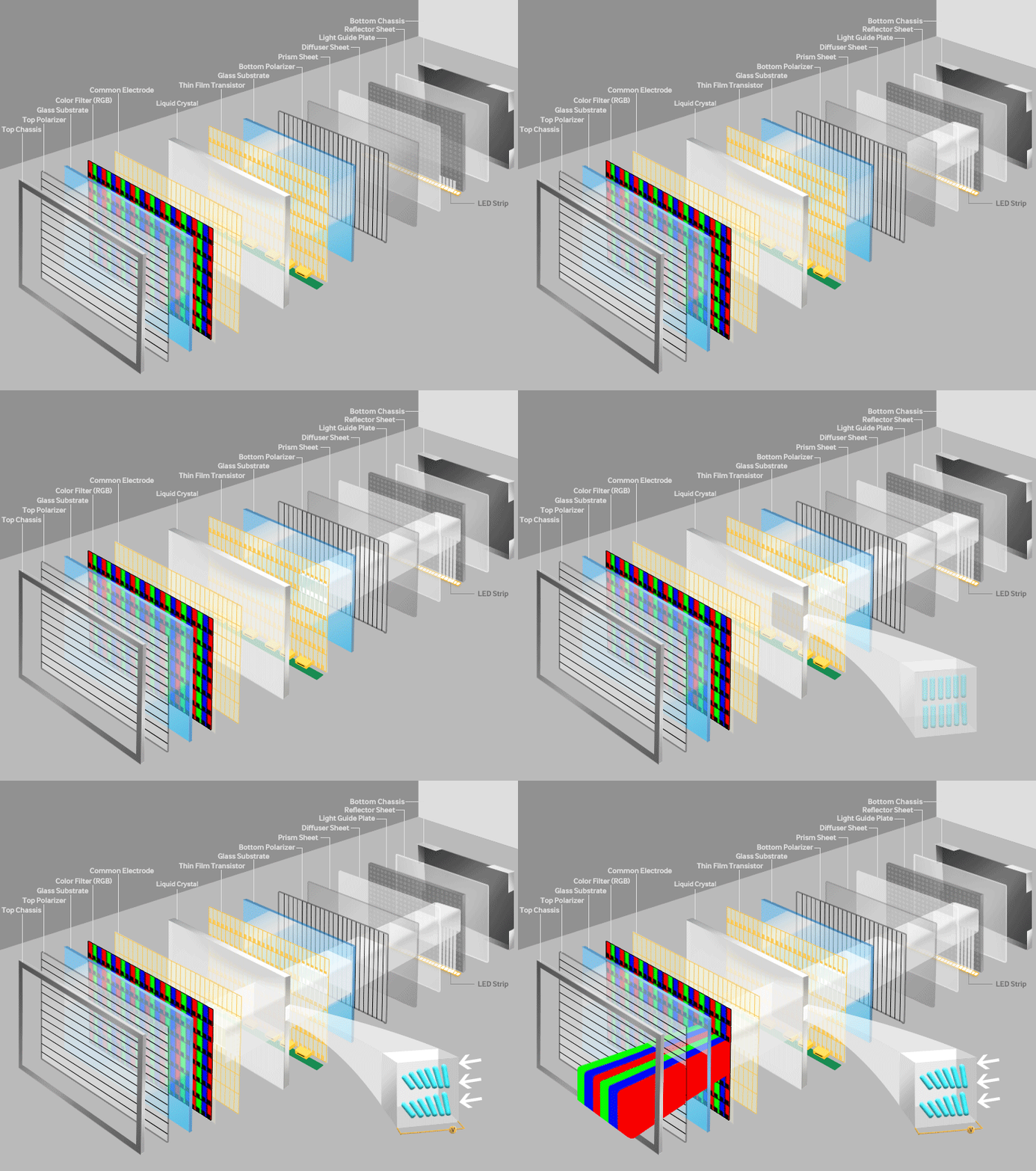
LCD (Liquid Crystal Display) panel is a display technology widely used in televisions, computer monitors, smartphones and other electronic devices. The operation of an LCD panel is based on electrically controlled liquid crystals.
The LCD panel contains the basic components in two layers of glass.
A thin layer of liquid crystals is located between the glass panels. This layer is responsible for displaying the image. The molecules of liquid crystals have the property of being able to change the polarization of light when they are electrically influenced.
Backlight: Behind the LCD panel is a lighting system, usually consisting of LEDs. The backlight ensures the visibility of the image and allows the light falling through the liquid crystal layer to be properly distributed. The backlight is constantly on, and its light intensity is adjusted using PWM control. Desktop monitors typically have a brightness of 250-350 nits, industrial monitors typically have a brightness of 350-450 nits, and high-brightness industrial monitors typically have a brightness of 1000-2000 nits.
The LEDs are placed on the edges of the monitor, and a light-conducting film and a diffuse film are used to ensure uniform illumination, which ensures uniform illumination over the entire surface of the image area.
Light filtering: The LCD panel is initially in a transparent state. Due to the transparency, the light from the backlight passes through the liquid crystal layer and then through the first glass panel. This results in white light in the display.
Application of electrical voltage: When an electrical voltage is applied to the LCD panel, it passes through the liquid crystal layer and affects the arrangement of the liquid crystal molecules. This arrangement determines the change in polarization of the light.
Polarization change: The arrangement of the liquid crystals changes the polarization of the light, and this polarized light passes through the second glass panel.
Light blocking/transmitting: By appropriately changing the arrangement of the liquid crystal molecules, the LCD panel can block or transmit light. This creates an image.
A transparent electrode in the LCD panel controls the electrical voltage and the arrangement of the liquid crystal. The state of the electrode and the applied voltage determine how the liquid crystal molecules arrange themselves. This arrangement affects the polarization of the light, and thus allows the image to be formed on the display.
In LCD panels, the full range of colors is created by combining and repeating the RGB (red, green, blue) primary colors row by row. By changing the electrode states and the applied voltages, the liquid crystal layer transmits or blocks the backlight according to the given color. An RGB combination gives us an elementary level, and the entire image is made up of a series of these elements. The monitor pixels are controlled row by row, from which the human eye sees a uniform image.
The operation of the LCD panel is therefore based on the electrically controlled polarization of the liquid crystal layer, which allows light to be blocked or transmitted, and thus the image to be displayed on the display.
The LCD panels of touch screen monitors operate on the same principle, the difference being that the touch screen is placed in front of the LCD panel, which in the case of a PCAP touch screen is also a glass plate with a sensor, and in the case of a resistive touch screen it is a highly transparent film.